MasterFabric Logo
v1.7
AI-Portfolio

MasterFabric · LLM Serving Bench

Measured LLM serving benchmarks comparing llama.cpp and MLX on Apple Silicon across quantization, concurrency, context and speculative decoding.
sha 83af7fe·snapshot 2026-11-23·View on GitHub →
MasterFabric LLM Serving Bench: throughput, prefill, KV cache and quantization measured on an M4 Pro

Overview

This repo measures LLM serving performance on servers that actually ran, rather than borrowed numbers: aggregate throughput, time to first token and inter-token latency against concurrency, prefill cost against prompt length, weight quantization (Q4_K_M, Q8_0, F16), KV-cache quantization and prompt-cache reuse. It compares llama.cpp on an Apple M4 Pro GPU via Metal against the same server in a CPU-only container and against Apple's MLX engine, with the main runs repeated on a MacBook Air M5. It also measures a long-context curve from 512 to 31k tokens and speculative decoding with a 0.5B draft model against 1.5B and 7B targets. Every number comes from a file in results/, generated by scripts in bench/, and the serving defaults chosen here feed the companion masterfabric-onprem-llm-stack repo.
Key measured results

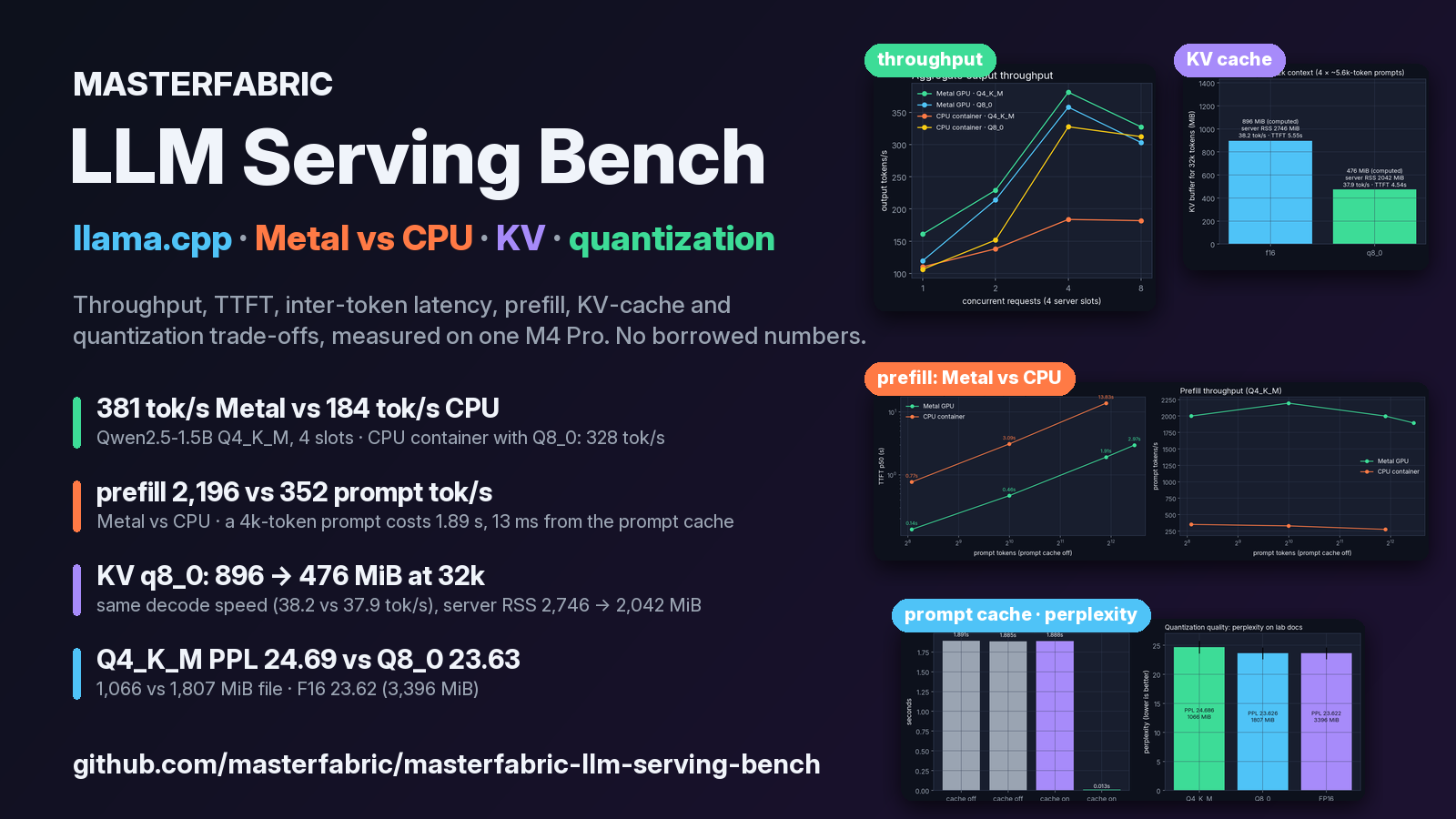
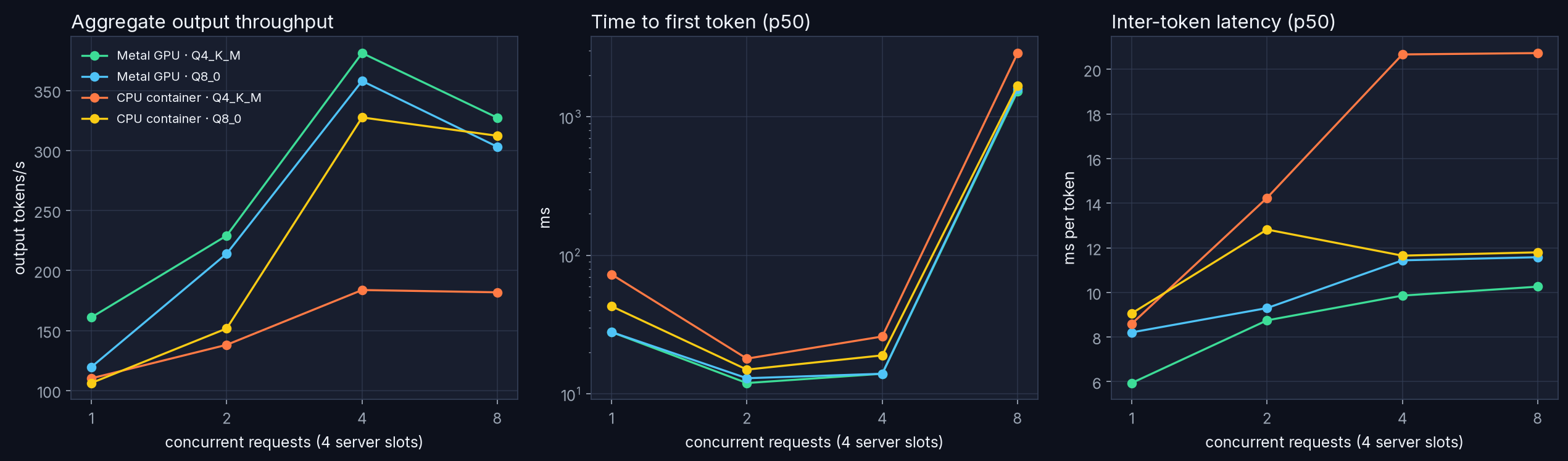
  • 01Peak output throughput, Q4_K_M, 4 concurrent requests: 381 tok/s on the Metal GPU vs 184 tok/s in the CPU container
  • 02Peak output throughput, Q8_0, 4 concurrent: 358 tok/s Metal vs 328 tok/s CPU container (reproduced in a second run at 335 vs 181)
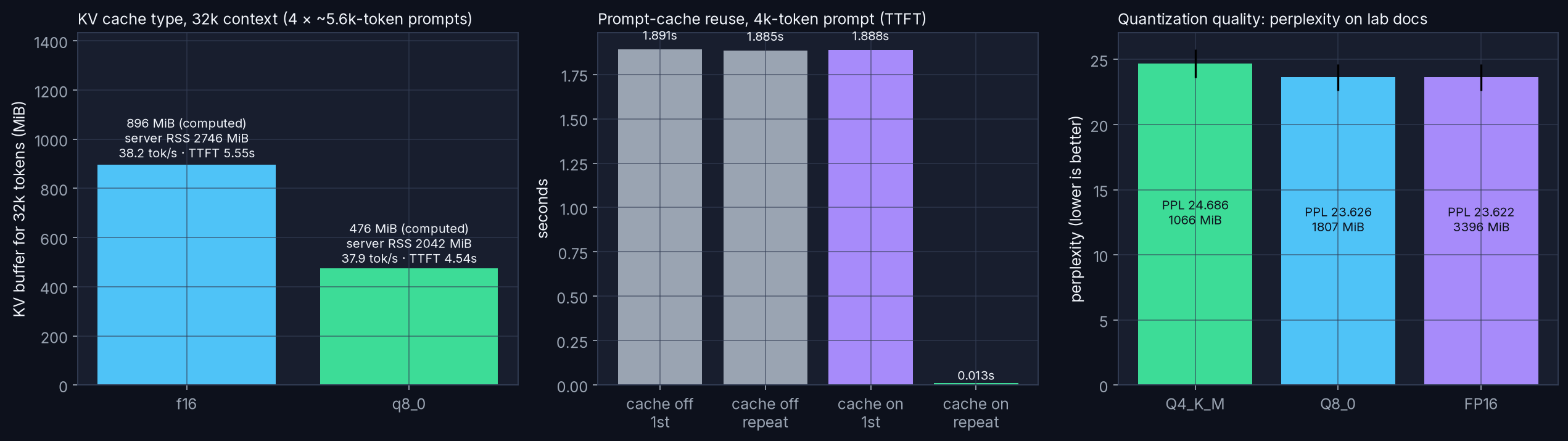
  • 03Q4_K_M costs little quality: perplexity 24.69 ± 1.09 vs 23.63 ± 1.04 for Q8_0 (F16: 23.62 ± 1.04), for a 41% smaller file
  • 04A q8_0 KV cache halves KV memory at the same speed: at 32k context, 896 to 476 MiB KV buffer (computed), server RSS 2,746 to 2,042 MiB (measured), 38.2 vs 37.9 tok/s
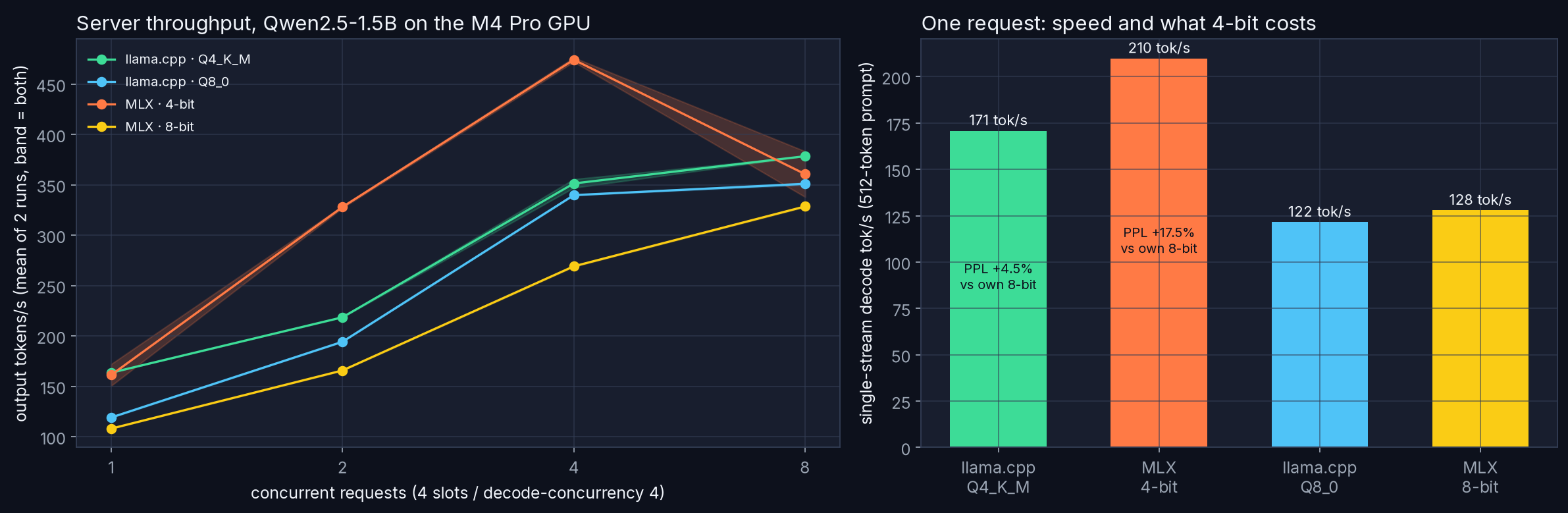
  • 05MLX is faster at 4-bit but loses more quality: one request 210 vs 171 tok/s, server peak 474 vs 378 tok/s; perplexity rises 17.5% over MLX's own 8-bit vs 4.5% for Q4_K_M
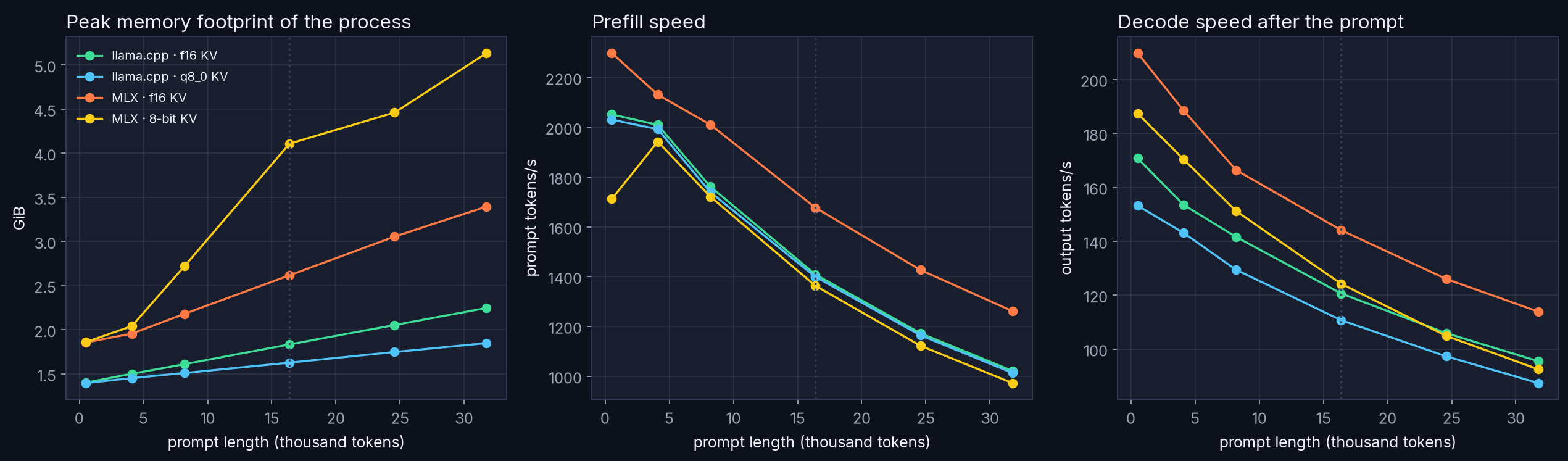
  • 06Long context from 512 to 31,744 prompt tokens: llama.cpp peak footprint grows 1.40 to 2.25 GiB (1.85 GiB with a q8_0 KV cache) and decode falls 171 to 96 tok/s; MLX stays faster at 114 tok/s at 31k but peaks at 3.40 GiB
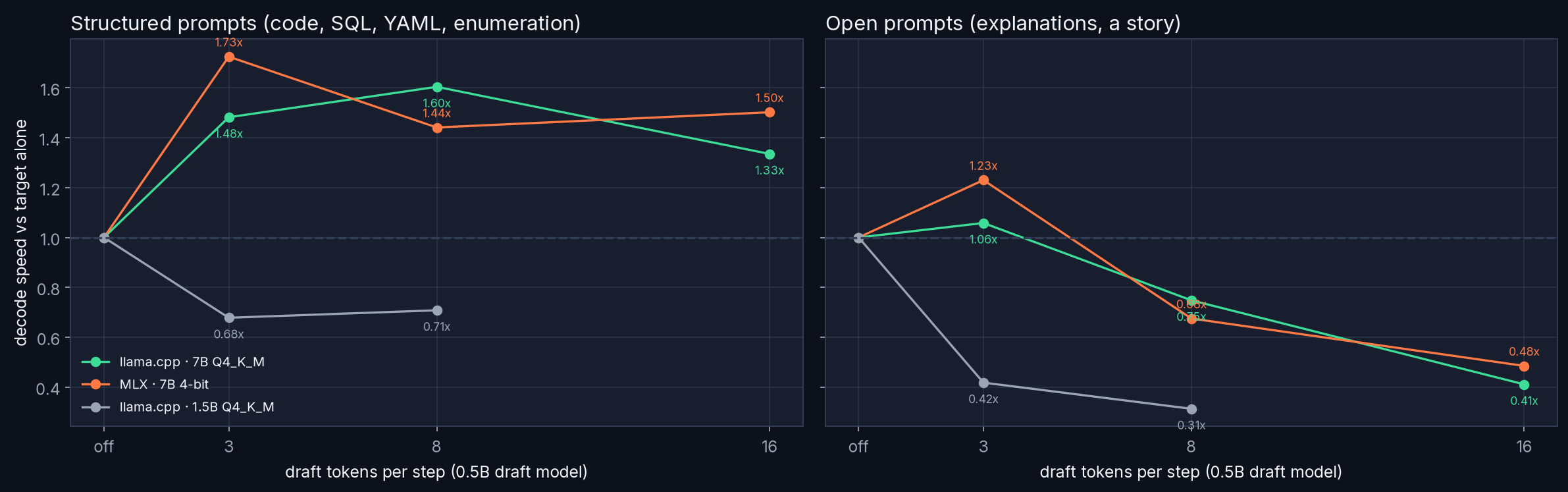
  • 07Speculative decoding with a 7B target and 0.5B draft: 1.60x (llama.cpp) and 1.73x (MLX) speed-up on code/SQL/YAML, but 0.41-0.49x on open text with 16 draft tokens; always slower (0.31-0.71x) on a 1.5B target
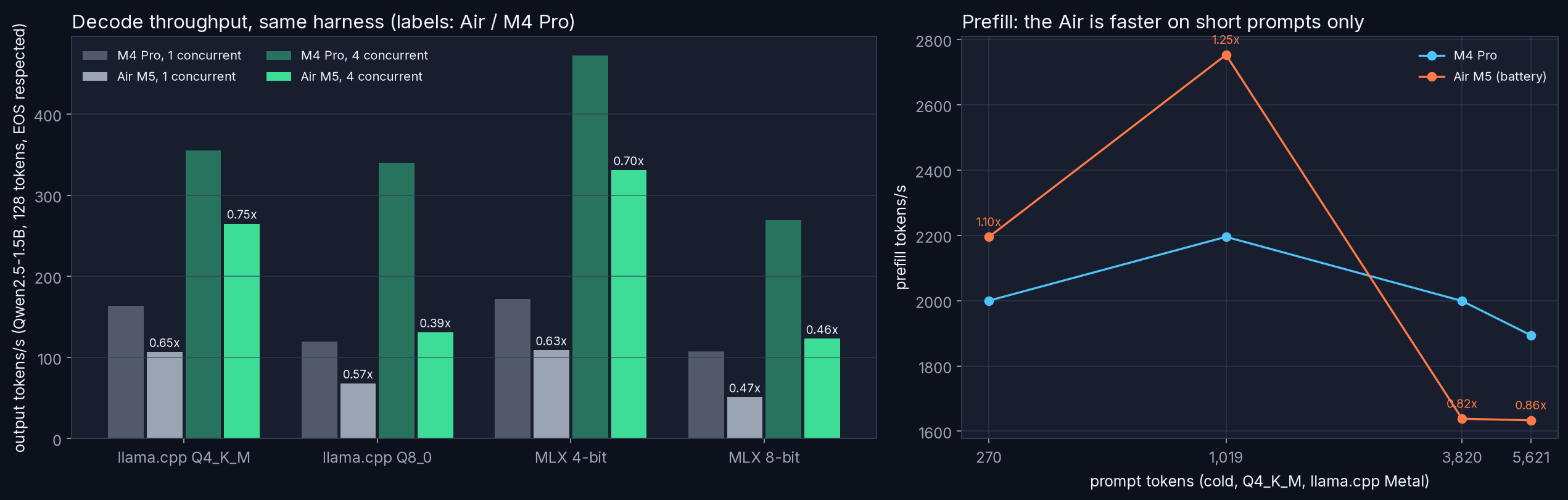
  • 08A MacBook Air M5 decodes at 0.57-0.75x the M4 Pro with llama.cpp, but prefills short prompts faster (2,753 vs 2,196 prompt tok/s at ~1k tokens) and long prompts slower (1,638 vs 1,999 at 3.8k)
  • 09The prompt cache turns a 1.89 s prefill into 13 ms for a repeated 4k-token prompt, at no cost on the cold request (1.888 s vs 1.891 s)
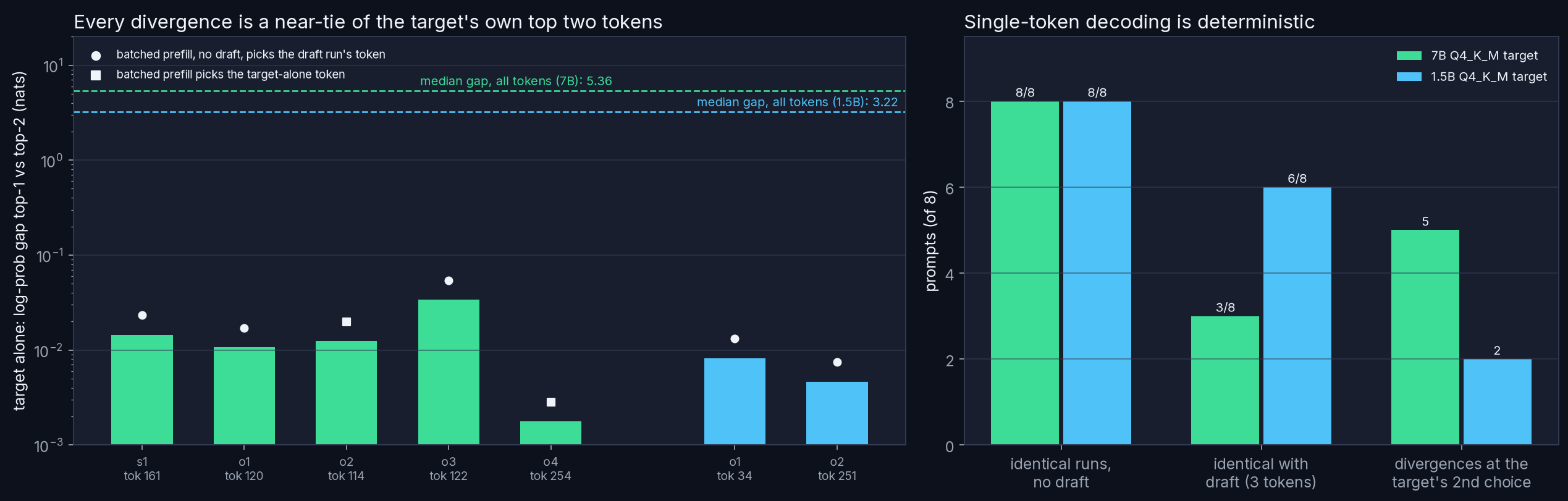
  • 10Every one of the 5 draft-vs-target output divergences (7B, 8 prompts) happened where the target's own top two tokens were within 0.002-0.034 nats, against a median gap of 5.36 nats over all tokens

Honest limitations

  • No GPU server and no vLLM run: the lab has no NVIDIA GPU, so 'GPU' means the Apple M4 Pro through Metal; vLLM numbers could be added without code changes but none are claimed
  • The MacBook Air ran on battery, once: on 2026-11-23 the M4 Pro was offline, so the Air runs and the mismatch study were done there (battery 43% to 21%, low power mode off, one run per configuration); an unexplained throughput discrepancy (213 vs 131 tok/s at 4 concurrent Q8_0) between two sweeps makes the Air numbers indicative, and the CPU container and long-context runs were not repeated there
  • The mismatch study ran on one machine and one build; the batched-vs-single-token kernel explanation is inferred from the batched-prefill test and near-tie gaps, not from reading the Metal kernels, and decode speeds in the mismatch results include the cost of returning top-2 probabilities and are not benchmarks
  • Ollama is installed but was not measured, since its server was not running and the repo does not start or change long-lived services
  • Only one small model (Qwen2.5-1.5B) was tested with short runs and a single repetition per configuration; there are no confidence intervals for latency
  • Laptop conditions such as other apps, thermal state and a background model download during the first runs were not controlled
  • The concurrency sweep uses short prompts (~48 tokens) that llama.cpp may serve partly from the prompt cache, so its TTFT measures queueing rather than prefill
  • KV buffer sizes are computed rather than read from the server, and RSS includes weights and compute buffers
  • The two llama.cpp builds differ between host (12359) and container (12464)
  • MLX vs llama.cpp is not bit-for-bit matched: the 4-bit formats differ in size and quality, and the MLX server cannot ignore EOS
  • Speculative decoding was measured with one request at a time and 8 prompts; gains are usually smaller under concurrent load on a GPU server
  • The long-context curve used one request per point with no repetitions, and the MLX 8-bit KV memory increase was observed but not explained
  • Perplexity on 38 KB of text is a coarse quality signal, not a task evaluation, and the Q4_K_M/Q8_0 difference is within error bars
  • The Q8_0 > Q4_K_M result on CPU was reproduced but not profiled; the cause is a hypothesis about CPU kernel differences on ARM

Screenshots & diagrams

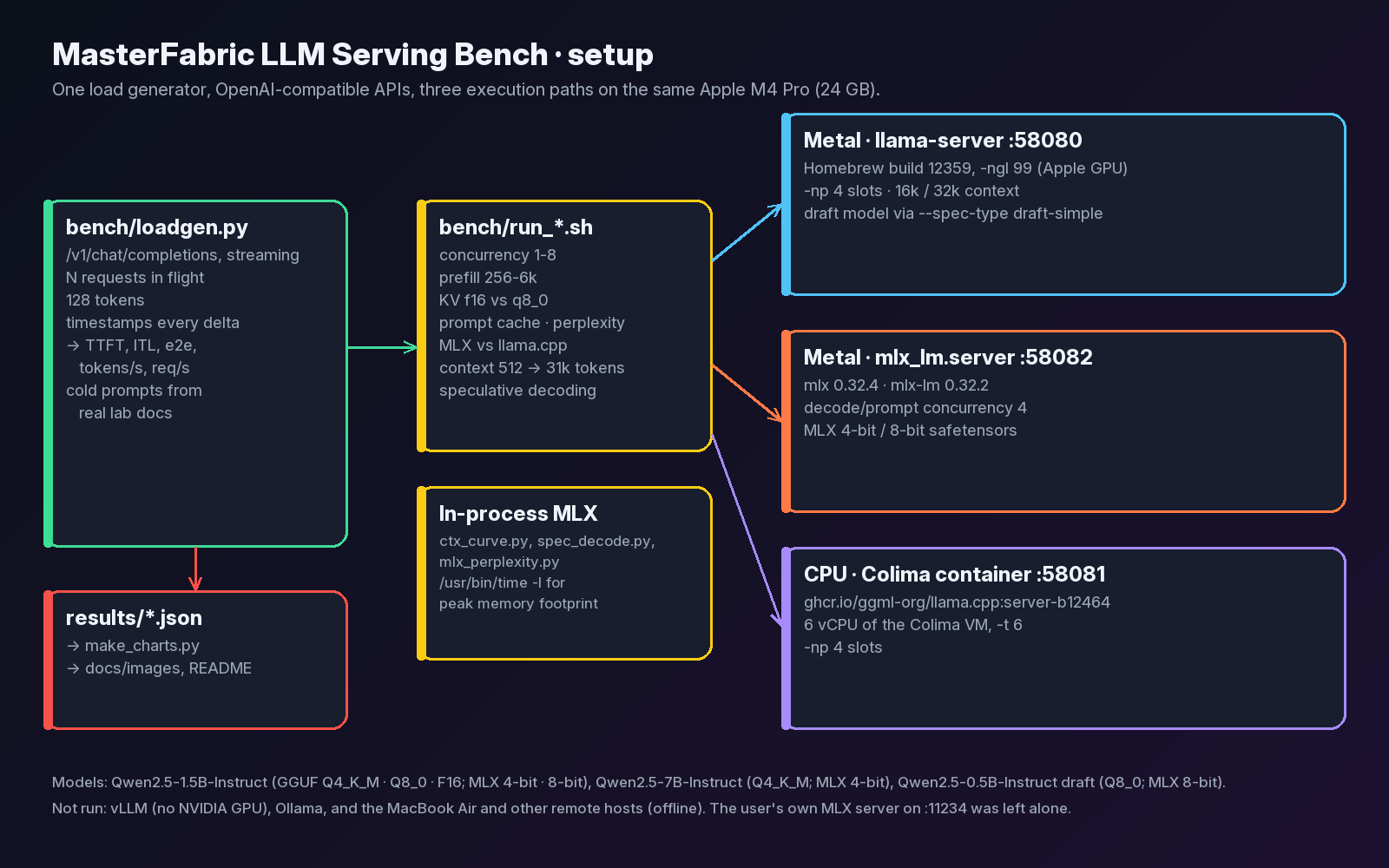
Benchmark setup: load generator, run matrix, Metal and CPU servers
Throughput, TTFT and inter-token latency against concurrency
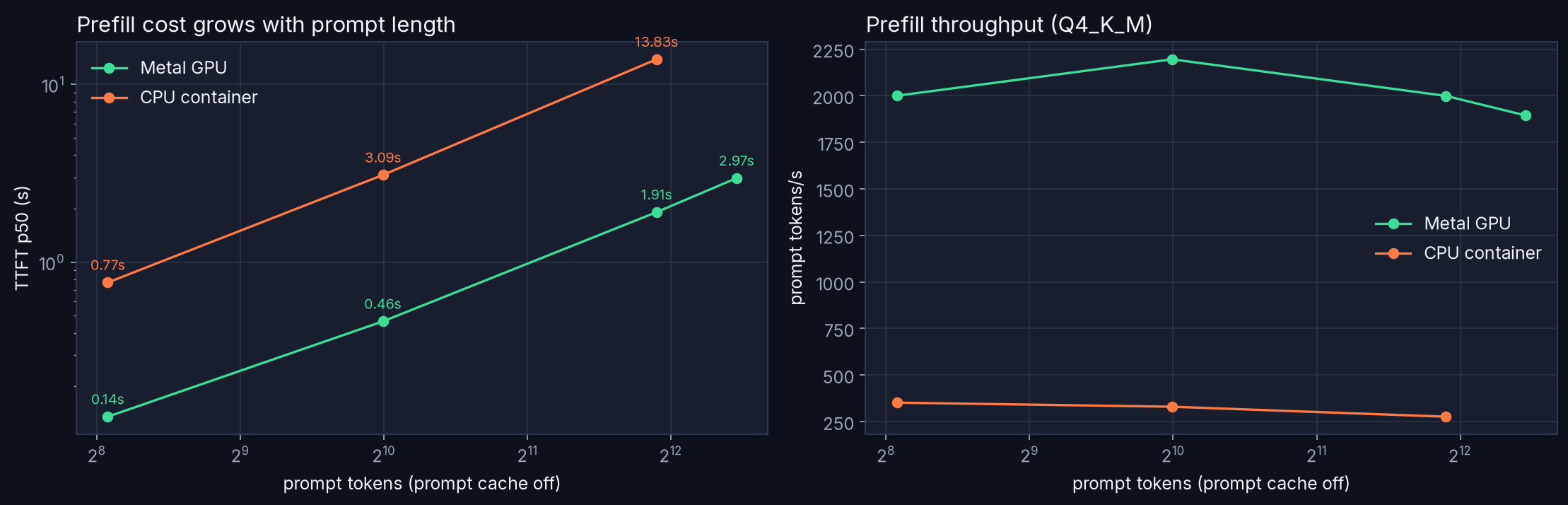
TTFT and prefill throughput against prompt length
KV cache type, prompt-cache reuse and perplexity by quantization
Server throughput against concurrency for llama.cpp and MLX at 4 and 8 bits, and single-stream decode speed with the perplexity cost of 4-bit
Peak memory footprint, prefill speed and decode speed against prompt length for llama.cpp and MLX with f16 and 8-bit KV caches
Decode speed-up from a 0.5B draft model by number of draft tokens, for structured and open prompts
Log-probability gap between the target's top two tokens at each divergence, all below 0.04 nats against a median gap of 5.36 over all tokens; repeats identical 8 of 8, with a draft 3 of 8 (7B) and 6 of 8 (1.5B)
Decode throughput on the Air M5 at 0.39 to 0.75 times the M4 Pro for llama.cpp and MLX, and prefill tokens per second against prompt length